I recently finished writing a narrative prototype that explores an alternative ending scenario for the Telltale Batman series titled Batman: The Enemy Within. I completed the prototype as an exercise in writing game narratives. The idea of games having stories with depth that rivals that of a novel is relatively new in the history of gaming, and with branching narratives in particular being largely uncharted territory, I wanted to explore challenges in writing game narratives and develop effective design methods in composing a game narrative.
In this post I will talk about the specifics of my design process as well as the iteration process that went into the design of my Batman: The Enemy Within story.
To begin, I composed a list of interesting questions that are posed in the Batman stories, and of that list I would choose 1 or 2 interesting questions to explore in my prototype. The list of questions included:
1.) What sacrifices does Batman have to make in order to be Batman?
2.) Does Batman make Gotham a better place or a worse place?
3.) Did Batman create the Joker somehow?
4.) Is Batman as crazy as the people he locks up in Arkham?
5.) Does Batman’s code to not kill actually hurt Gotham?
6.) Is Gotham worth saving?
7.) What is Batman’s own enemy within? The Joker’s?
In the end, I decided to explore Batman’s moral code of not killing. That is not to say that I would avoid other questions entirely, but instead I would focus on that one core question in my design and I suspected that other questions would come up more naturally throughout the process. I liked the idea of exploring the question of not killing because it provided a clear binary that would be manageable yet still interesting in terms of player choice and branching narrative. It also allowed me to forego using too many narrative branches early on. One of my initial goals was to avoid overwhelming myself with too many narrative options and then ending up spreading myself too thin.
With my question decided, I thought about which villain would make the most sense in this story. My mind immediately went to the Joker, because Joker is the one villain who constantly seeks to make Batman question his own morality. My mind also kept coming back to this idea of a funhouse or a game show (I guess you could say I was “Listening to my subconscious,” as Jesse Schell outlines in his book “The Art of Game Design”), so the pieces slowly started to come together and I was able to create my first prototype.
One challenge that I have as a writer is that I always feel like my first draft needs to be way more polished than a first draft ever actually is. I always feel like all of the narrative beats need to be present and the overall story needs to be there, but my experience as a game designer has taught me that is seldom ever the case. In fact, the design process is a long and iterative process with your final product often being very different from what you started with. Luckily, my designer self superseded my writer self, and I was able to dive into the trenches and write something that was very rough. I wasn’t extremely proud of it, but I was proud that I was able to get something finished and in a relatively short amount of time.
For the iteration phase, I had people playtest the story by playing through the interactive prototype on Twine. The feedback I received was useful, and it really helped me think about both player decisions and the authenticity of the characters. I received the feedback that the first prototype felt like the Joker’s fantasy. The Joker has all of the powerful in the story and Batman has none. In fact, he barely even has a voice. One problem that I discovered with the first iteration is that Batman plays strictly by the Joker’s rules and doesn’t challenge him on anything. He just does what the Joker says. Take the example below:
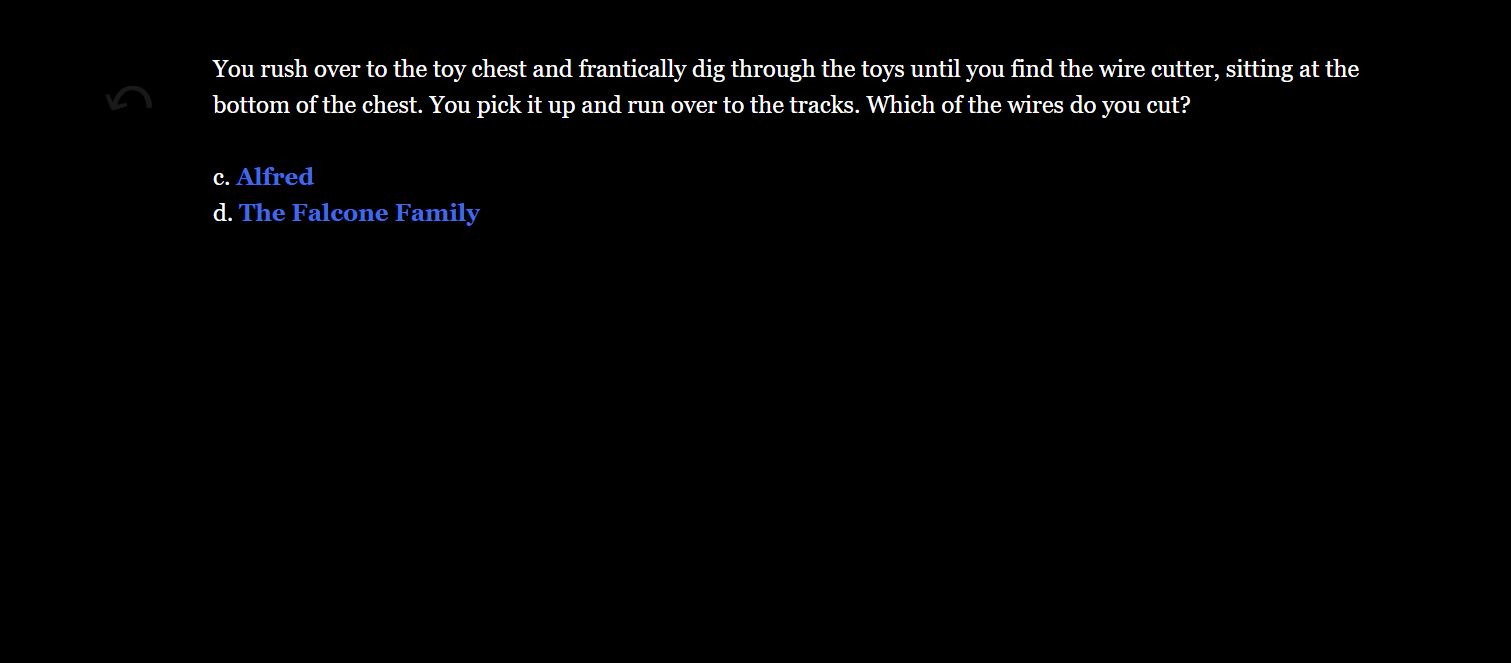
In the above example, Batman is given a choice to save Alfred or to save a group of criminals from the Falcone crime family. The player does not have the ability to have Batman speak up or defy expectations. In my iterative process, I not only added more options for the player, but included options that gave Batman the power to speak and in some cases, break the rules of Joker’s game entirely.
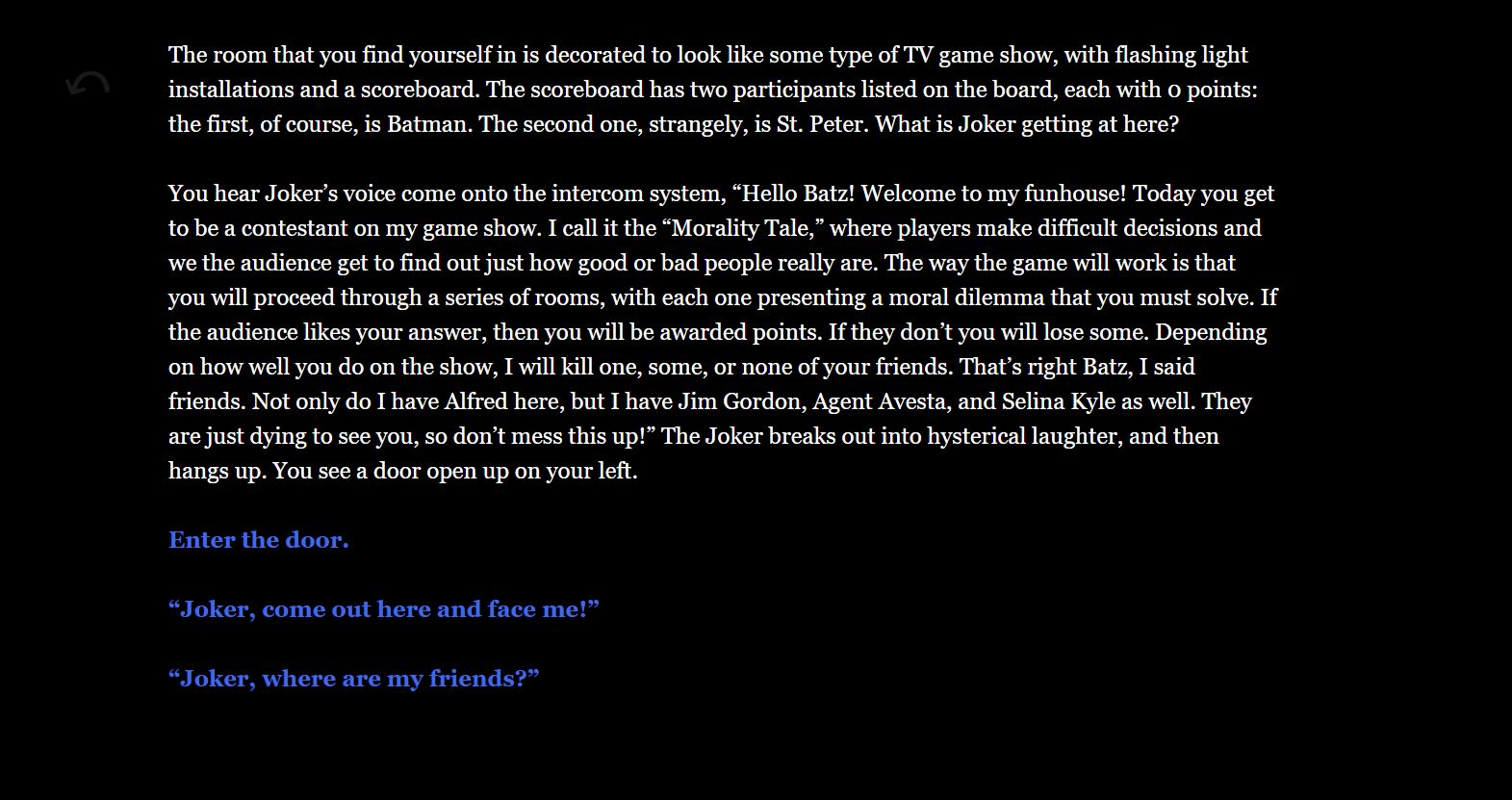
Through this process, players gained more initiative, Batman started to feel more three dimensional, and the game became more fun. I followed a strategy similar to that of Telltale Games, where players are given many options throughout the game, but only a select few change the course of the story in a significant or permanent way, with other options either changing only small parts of the story or simply looping back to the main story. I don’t think that my narrative branches and story threads are perfect, but I am pleased with the progress that I made in such a short amount of time.
This project has really helped to prepare me for future narrative prototyping and has helped me to develop an effective design process that will help me to be more efficient in developing future prototypes.

 Justin's Game Design Blog